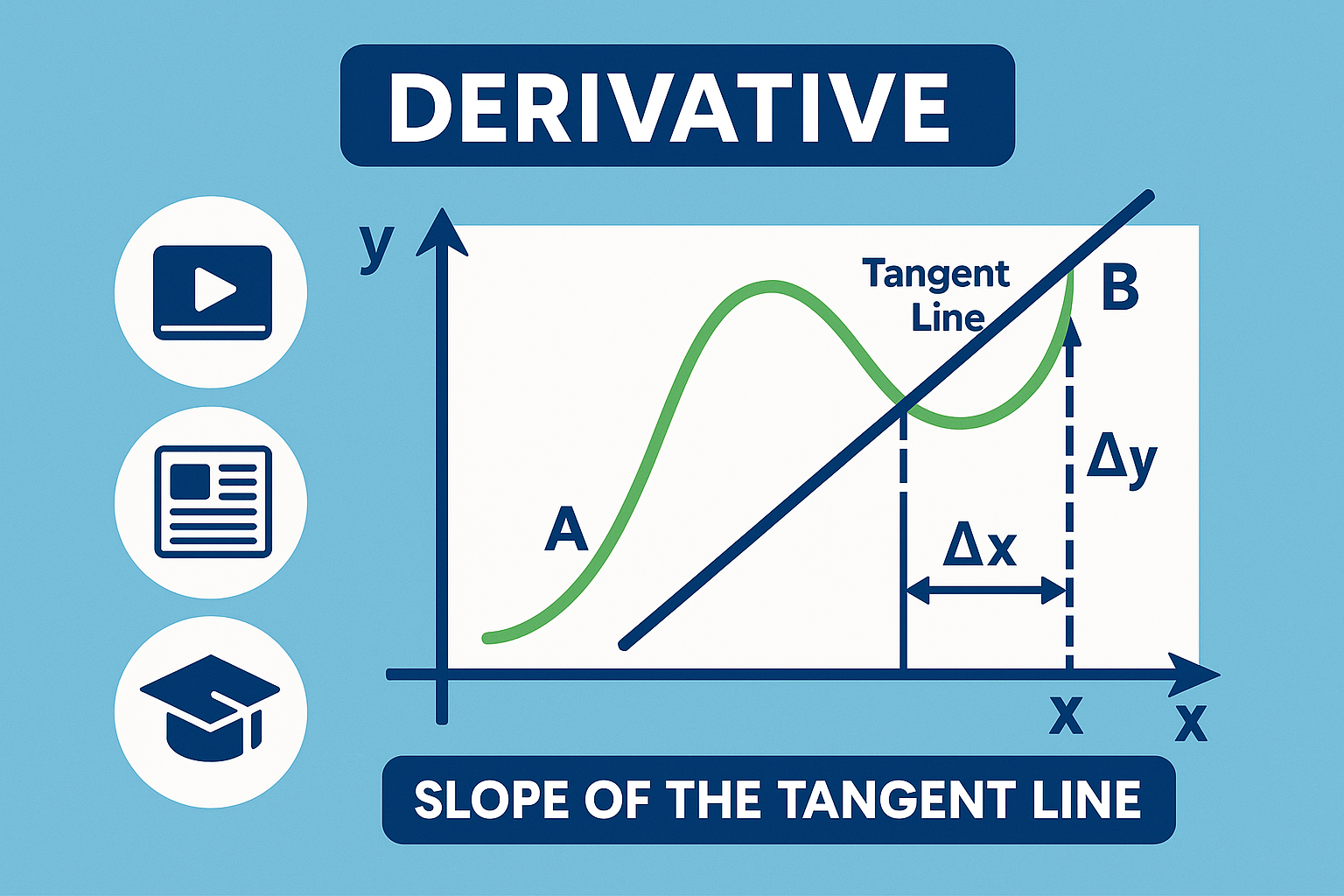
Understanding Derivatives: The Slope of the Tangent Line
Understanding Derivatives: The Slope of the Tangent Line
What Is a Derivative? The Slope-of-the-Tangent-Line Idea
A derivative tells you the slope of the tangent line to a curve at any point you choose. That one idea is the heart of calculus. Let's break down what it means and how you can find derivatives when you need them.
Understanding the Concept of a Derivative
A derivative is about change. It measures how fast a function's output shifts as its input moves. Picture a curve on a graph. At any single point on that curve, you can draw a straight line that just grazes it — that's the tangent line. The slope of that line is the derivative at that point. In other words, the derivative answers the question: how steep is the curve right here?
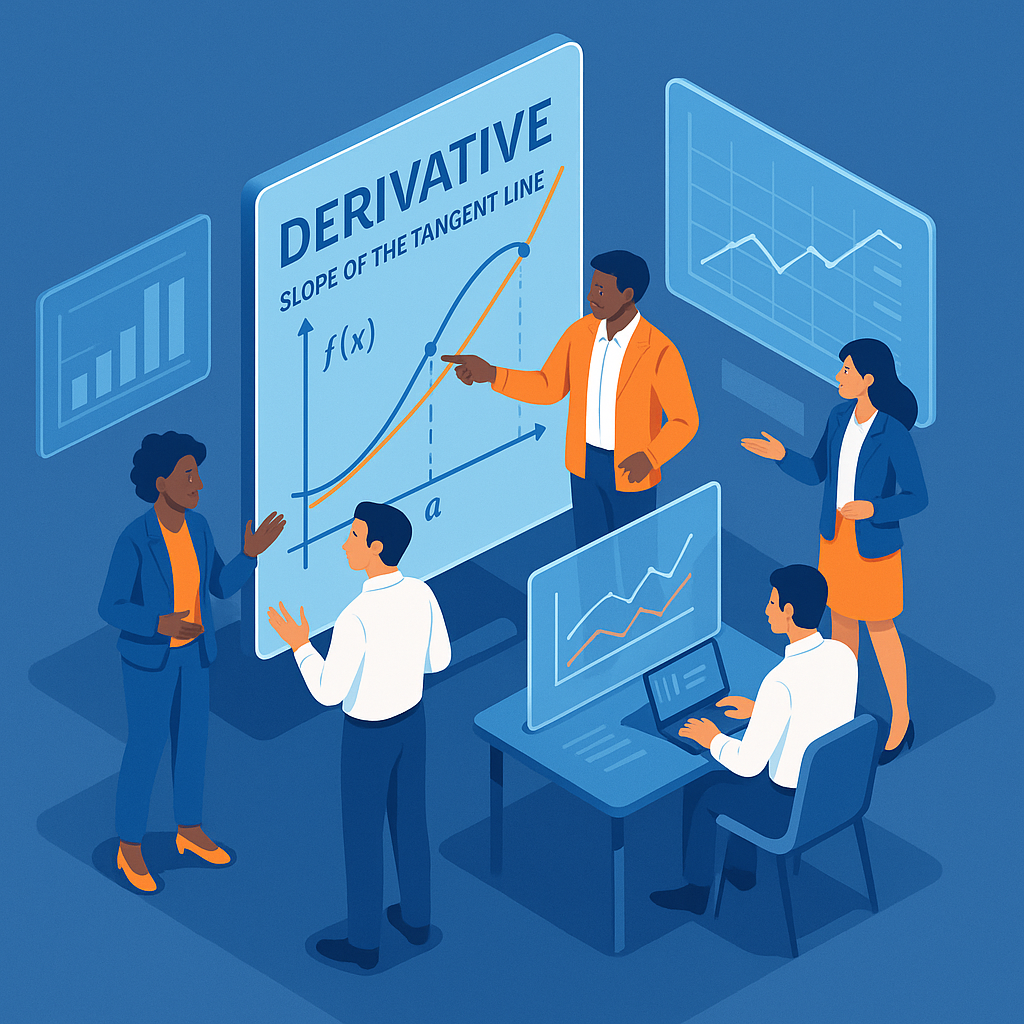
Step-by-Step: Finding the Derivative
Let's break it down with a concrete example. Say your function is f(x) = x2. Here's how you find its derivative, one step at a time:
- Look at the exponent on x. Right now it's 2. Bring that number down in front of x so it becomes the coefficient.
- Subtract one from the original exponent. That turns x2 into x1.
- Put it together. The derivative of x2 is 2x.
Notice that every step focuses on the exponent and the coefficient — nothing else. Here's why it works: each step is just a shortcut for a longer limit calculation. The pattern holds for any term written as a power of x, so once you know these steps, you can apply them again and again.
Why Derivatives Matter
Derivatives show up far outside the math classroom. In physics, the derivative of an object's position with respect to time is its velocity. That tells you exactly how fast something is moving at any given moment — not just on average, but right now.

In economics, derivatives can represent marginal cost or marginal revenue. Notice that knowing the rate of change — not just the total — is what lets a business decide whether to produce one more unit or pull back. That's the kind of decision derivatives make possible.
Recap: The Power of Derivatives
Here's why derivatives are worth your time: they describe exactly how any function is changing at any moment. That skill travels across engineering, finance, physics, and more. Once you can find a derivative, you can read the behavior of a function instead of just guessing at it.
For further learning, explore our detailed guides on The Power Rule Explained With Examples and The Constant Rule and Why Constants Disappear. These will help you build on what you've learned here and move into more advanced calculus with confidence.
If you want to keep going, bookmark our series of mini-lessons. Each one is built to fit in a single sitting, so you can make steady progress without feeling buried. You build one idea at a time, and each new idea connects back to something you already know.
Notice that learning derivatives isn't only about getting the right answer. It's about spotting the pattern and knowing why it works. Once that clicks, you can carry it into problems you've never seen before. That's the goal — and you're already on your way.
Practical Applications of Derivatives in Everyday Life
Derivatives show up in daily life more than you might expect. Think about driving a car. Your speedometer is giving you a live derivative: your velocity, which is the rate of change of your position over time. When you read that number and decide to speed up or slow down, you're acting on derivative information. You're using calculus without calling it that.
Derivatives in Technology and Innovation
In technology, derivatives help optimize the algorithms behind search engines and social media feeds. Here's why that matters: those algorithms need to measure how a change in input — say, a new click or a longer watch time — affects the output, like which post you see next. Derivatives give engineers a precise way to track that relationship and tune the system toward better results.
Checklist for Applying Derivatives in Business
- Identify Key Performance Indicators (KPIs): Decide which metrics in your business change over time, such as customer acquisition cost or sales growth rate.
- Calculate Derivatives: Use derivatives to find the rate of change of those KPIs, so you can spot trends before they become obvious.
- Optimize Strategies: Take what the derivatives tell you and use it to adjust marketing, product development, and how you allocate resources.
- Monitor and Adapt: Keep tracking the changes and update your models so your decisions stay grounded in current data.
FAQs: Common Questions About Derivatives
What is the difference between a derivative and a differential?
A derivative gives you the rate of change of a function — in other words, the slope at a specific point. A differential describes the actual change in the function's output when the input shifts by a small amount. Think of the derivative as the steepness of the hill, and the differential as how far you actually move up or down when you take one small step.
How do derivatives help in risk management?
In finance, derivatives let you model how an asset's value responds to changes in market conditions. Notice that once you know that rate of change, you can plan around it. Investors use this to hedge against potential losses — for example, in options trading, the derivative helps you figure out the best moment to act so you protect your position or lock in a gain.
Follow Author
Get notified when new posts are published