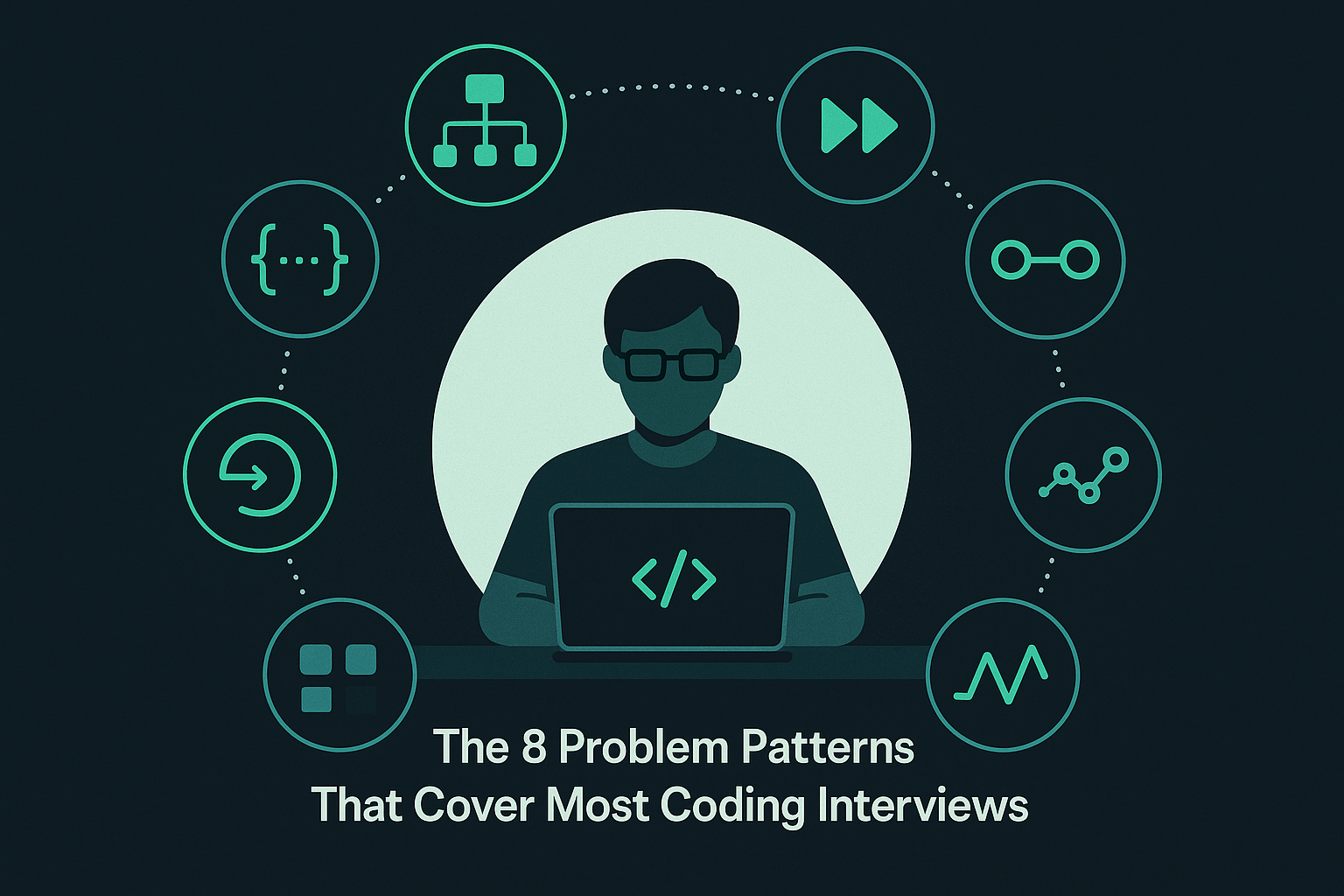
The 8 Problem Patterns That Cover Most Coding Interviews
The 8 Problem Patterns That Cover Most Coding Interviews
The 8 Problem Patterns That Cover Most Coding Interviews
The 8 Problem Patterns That Cover Most Coding Interviews

Let's dive right into what you need to know to ace your next coding interview. Whether you're a gig delivery rider looking to transition into tech or a beginner developer, understanding these problem patterns is your first step to success. Forget the fluff, this is about real strategies that work.
1. Array Manipulation
Array manipulation problems are a staple in coding interviews. You'll often be asked to traverse, sort, or modify arrays in specific ways. Start by mastering techniques like two-pointer approaches and sliding windows. These methods help solve problems efficiently, especially when dealing with large datasets.
For example, consider the problem of finding the maximum sum of a subarray. A common approach is the Kadane's Algorithm, which runs in linear time and is a favorite in interviews.
2. String Processing
Strings are another favorite. You'll need to handle tasks like reversing strings, checking for palindromes, or finding substrings. The key is understanding how to manipulate characters and utilize data structures like hashmaps for performance gains.
One classic problem is the "Longest Substring Without Repeating Characters." Using a sliding window technique with a hashmap can optimize your solution to run in linear time.
3. Linked Lists
Linked lists are all about pointers. You might be asked to reverse a linked list or detect cycles. These problems test your understanding of data structure manipulation and memory management.
A typical question might involve merging two sorted linked lists. The trick is to use a dummy node to simplify the merging process, ensuring your code remains clean and efficient.
4. Tree Traversal
Trees are a hierarchical data structure, and interviewers love them. You'll need to know how to traverse them using pre-order, in-order, and post-order techniques. Understanding recursion is crucial here.
Consider the problem of finding the lowest common ancestor in a binary tree. Using a recursive approach can simplify the problem, making it easier to implement and understand.
5. Graph Algorithms
Graphs are more complex but incredibly rewarding to master. Expect tasks involving depth-first search (DFS) or breadth-first search (BFS). These algorithms are foundational for solving problems related to connectivity and pathfinding.
For instance, you might be asked to detect a cycle in a directed graph. Using a DFS approach with a visited set can help you find cycles efficiently.
6. Dynamic Programming
Dynamic programming (DP) is all about breaking down problems into simpler subproblems. It's used to optimize recursive algorithms by storing results of expensive function calls and reusing them.
A typical DP problem is the "0/1 Knapsack Problem." By using a table to store previous results, you can reduce the time complexity significantly compared to a naive recursive solution.
7. Sorting and Searching
Sorting and searching algorithms are fundamental. You'll often need to implement or optimize these algorithms to solve other problems. Understanding quicksort, mergesort, and binary search is essential.
Imagine being asked to search for an element in a sorted array. A binary search can quickly narrow down the possibilities, making it much faster than a linear search.
8. Backtracking
Backtracking is used for problems that require exploring all potential solutions. It's commonly used in puzzles like Sudoku or the N-Queens problem. The goal is to build a solution incrementally and backtrack when a solution can't be completed.
For example, solving a Sudoku puzzle involves placing numbers in a grid, ensuring that each number appears only once per row, column, and subgrid. Backtracking helps manage the complexity by eliminating paths that don't lead to a solution.
Wrapping It Up: Next Steps to Mastery

Now that you've got a handle on the essential coding interview patterns, it's time to practice. Use platforms like LeetCode or HackerRank to find problems that fit these patterns and solve them regularly. Consistent practice will solidify your understanding and improve your problem-solving speed.
For gig delivery riders looking to cut fuel costs and transition into tech, The E-Bike Hustle offers a practical way to start saving while you learn. By combining the hustle of delivery with the potential of tech, you can create a sustainable path to a new career.
Remember, the key is to keep hustling, keep learning, and never stop pushing forward. You've got the playbook—now it's time to make it happen!
Advanced Techniques for Mastering Coding Interview Patterns

Enhancing Array Manipulation Skills
While mastering the basics of array manipulation is crucial, advanced techniques can set you apart. Consider learning about prefix sums and difference arrays. These can optimize performance in range query problems where frequent updates and queries are required. Another technique is Fenwick Trees (or Binary Indexed Trees), which provide efficient methods for cumulative frequency tables.
For example, prefix sums can be used to quickly calculate the sum of any subarray. This method is particularly useful in problems where you must frequently compute sums over different segments of an array.
String Processing with Advanced Algorithms
Beyond basic string manipulation, understanding algorithms like KMP (Knuth-Morris-Pratt) for pattern matching can be beneficial. This algorithm improves the efficiency of searching a substring within a string by preprocessing the pattern to skip unnecessary comparisons.
Another advanced technique is the use of trie data structures for problems involving prefix searches or autocomplete functionalities. Tries allow for efficient storage and retrieval of strings, making them invaluable in applications like dictionary lookups.
Complex Linked List Operations
For linked lists, learning to implement more complex operations can be advantageous. Consider mastering techniques like skip lists, which are a form of linked lists that allow for faster search, insertion, and deletion operations compared to traditional linked lists.
Additionally, understanding how to handle flattened linked lists—where each node may point to a sublist—can prepare you for more complex interview questions that involve nested data structures.
Advanced Tree and Graph Techniques
In addition to basic traversal, learn about segment trees and range queries for trees. Segment trees can be used to solve problems involving interval queries efficiently, such as finding the minimum or maximum in a range.
For graphs, dive into algorithms like Dijkstra's and Floyd-Warshall for shortest path problems, and Prim's or Kruskal's for minimum spanning tree problems. These algorithms are fundamental for tackling complex network and optimization problems.
Optimizing Dynamic Programming Solutions
Beyond basic dynamic programming, explore memoization and tabulation techniques. Memoization involves storing the results of expensive function calls, while tabulation builds a table bottom-up to solve a problem iteratively.
Consider learning about bitmasking in dynamic programming, which is useful for problems involving subsets or combinations, such as the Traveling Salesman Problem. This technique reduces the complexity by using bits to represent the state of a solution.
Refining Sorting and Searching Techniques
To further enhance sorting and searching capabilities, explore counting sort, bucket sort, and radix sort. These algorithms can handle specific types of data more efficiently than general-purpose sorts like quicksort.
For search problems, consider ternary search, which divides the search space into three parts, offering a more refined approach than binary search in certain situations.
Advanced Backtracking Strategies
Backtracking can be further optimized by incorporating pruning techniques, which eliminate large portions of the search space early on. This can be particularly effective in constraint satisfaction problems like the N-Queens puzzle.
Another strategy is to utilize heuristics to guide the backtracking process, focusing the search on more promising paths and reducing the overall computation time.
Checklist for Interview Preparation
- Master basic and advanced algorithms for each problem pattern.
- Practice implementing algorithms from scratch to reinforce understanding.
- Use online platforms to simulate interview conditions and time constraints.
- Regularly revisit and refine solutions to previously solved problems.
- Engage in mock interviews with peers to improve communication skills.
By deepening your understanding of these advanced techniques and regularly practicing, you'll be well-equipped to tackle any coding interview with confidence.
The 8 Problem Patterns That Cover Most Coding Interviews
The 8 Problem Patterns That Cover Most Coding Interviews
Let's dive right into what you need to know to ace your next coding interview. Whether you're a gig delivery rider looking to transition into tech or a beginner developer, understanding these problem patterns is your first step to success. Forget the fluff, this is about real strategies that work.
1. Array Manipulation
Array manipulation problems are a staple in coding interviews. You'll often be asked to traverse, sort, or modify arrays in specific ways. Start by mastering techniques like two-pointer approaches and sliding windows. These methods help solve problems efficiently, especially when dealing with large datasets.
For example, consider the problem of finding the maximum sum of a subarray. A common approach is the Kadane's Algorithm, which runs in linear time and is a favorite in interviews.
2. String Processing
Strings are another favorite. You'll need to handle tasks like reversing strings, checking for palindromes, or finding substrings. The key is understanding how to manipulate characters and utilize data structures like hashmaps for performance gains.
One classic problem is the "Longest Substring Without Repeating Characters." Using a sliding window technique with a hashmap can optimize your solution to run in linear time.
3. Linked Lists
Linked lists are all about pointers. You might be asked to reverse a linked list or detect cycles. These problems test your understanding of data structure manipulation and memory management.
A typical question might involve merging two sorted linked lists. The trick is to use a dummy node to simplify the merging process, ensuring your code remains clean and efficient.
4. Tree Traversal
Trees are a hierarchical data structure, and interviewers love them. You'll need to know how to traverse them using pre-order, in-order, and post-order techniques. Understanding recursion is crucial here.
Consider the problem of finding the lowest common ancestor in a binary tree. Using a recursive approach can simplify the problem, making it easier to implement and understand.
5. Graph Algorithms
Graphs are more complex but incredibly rewarding to master. Expect tasks involving depth-first search (DFS) or breadth-first search (BFS). These algorithms are foundational for solving problems related to connectivity and pathfinding.
For instance, you might be asked to detect a cycle in a directed graph. Using a DFS approach with a visited set can help you find cycles efficiently.
6. Dynamic Programming
Dynamic programming (DP) is all about breaking down problems into simpler subproblems. It's used to optimize recursive algorithms by storing results of expensive function calls and reusing them.
A typical DP problem is the "0/1 Knapsack Problem." By using a table to store previous results, you can reduce the time complexity significantly compared to a naive recursive solution.
7. Sorting and Searching
Sorting and searching algorithms are fundamental. You'll often need to implement or optimize these algorithms to solve other problems. Understanding quicksort, mergesort, and binary search is essential.
Imagine being asked to search for an element in a sorted array. A binary search can quickly narrow down the possibilities, making it much faster than a linear search.
8. Backtracking
Backtracking is used for problems that require exploring all potential solutions. It's commonly used in puzzles like Sudoku or the N-Queens problem. The goal is to build a solution incrementally and backtrack when a solution can't be completed.
For example, solving a Sudoku puzzle involves placing numbers in a grid, ensuring that each number appears only once per row, column, and subgrid. Backtracking helps manage the complexity by eliminating paths that don't lead to a solution.
Wrapping It Up: Next Steps to Mastery
Now that you've got a handle on the essential coding interview patterns, it's time to practice. Use platforms like LeetCode or HackerRank to find problems that fit these patterns and solve them regularly. Consistent practice will solidify your understanding and improve your problem-solving speed.
For gig delivery riders looking to cut fuel costs and transition into tech, The E-Bike Hustle offers a practical way to start saving while you learn. By combining the hustle of delivery with the potential of tech, you can create a sustainable path to a new career.
Remember, the key is to keep hustling, keep learning, and never stop pushing forward. You've got the playbook—now it's time to make it happen!
Advanced Techniques for Mastering Coding Interview Patterns
Enhancing Array Manipulation Skills
While mastering the basics of array manipulation is crucial, advanced techniques can set you apart. Consider learning about prefix sums and difference arrays. These can optimize performance in range query problems where frequent updates and queries are required. Another technique is Fenwick Trees (or Binary Indexed Trees), which provide efficient methods for cumulative frequency tables.
For example, prefix sums can be used to quickly calculate the sum of any subarray. This method is particularly useful in problems where you must frequently compute sums over different segments of an array.
String Processing with Advanced Algorithms
Beyond basic string manipulation, understanding algorithms like KMP (Knuth-Morris-Pratt) for pattern matching can be beneficial. This algorithm improves the efficiency of searching a substring within a string by preprocessing the pattern to skip unnecessary comparisons.
Another advanced technique is the use of trie data structures for problems involving prefix searches or autocomplete functionalities. Tries allow for efficient storage and retrieval of strings, making them invaluable in applications like dictionary lookups.
Complex Linked List Operations
For linked lists, learning to implement more complex operations can be advantageous. Consider mastering techniques like skip lists, which are a form of linked lists that allow for faster search, insertion, and deletion operations compared to traditional linked lists.
Additionally, understanding how to handle flattened linked lists—where each node may point to a sublist—can prepare you for more complex interview questions that involve nested data structures.
Advanced Tree and Graph Techniques
In addition to basic traversal, learn about segment trees and range queries for trees. Segment trees can be used to solve problems involving interval queries efficiently, such as finding the minimum or maximum in a range.
For graphs, dive into algorithms like Dijkstra's and Floyd-Warshall for shortest path problems, and Prim's or Kruskal's for minimum spanning tree problems. These algorithms are fundamental for tackling complex network and optimization problems.
Optimizing Dynamic Programming Solutions
Beyond basic dynamic programming, explore memoization and tabulation techniques. Memoization involves storing the results of expensive function calls, while tabulation builds a table bottom-up to solve a problem iteratively.
Consider learning about bitmasking in dynamic programming, which is useful for problems involving subsets or combinations, such as the Traveling Salesman Problem. This technique reduces the complexity by using bits to represent the state of a solution.
Refining Sorting and Searching Techniques
To further enhance sorting and searching capabilities, explore counting sort, bucket sort, and radix sort. These algorithms can handle specific types of data more efficiently than general-purpose sorts like quicksort.
For search problems, consider ternary search, which divides the search space into three parts, offering a more refined approach than binary search in certain situations.
Advanced Backtracking Strategies
Backtracking can be further optimized by incorporating pruning techniques, which eliminate large portions of the search space early on. This can be particularly effective in constraint satisfaction problems like the N-Queens puzzle.
Another strategy is to utilize heuristics to guide the backtracking process, focusing the search on more promising paths and reducing the overall computation time.
Checklist for Interview Preparation
- Master basic and advanced algorithms for each problem pattern.
- Practice implementing algorithms from scratch to reinforce understanding.
- Use online platforms to simulate interview conditions and time constraints.
- Regularly revisit and refine solutions to previously solved problems.
- Engage in mock interviews with peers to improve communication skills.
By deepening your understanding of these advanced techniques and regularly practicing, you'll be well-equipped to tackle any coding interview with confidence.
The 8 Problem Patterns That Cover Most Coding Interviews
The 8 Problem Patterns That Cover Most Coding Interviews
Let's dive right into what you need to know to ace your next coding interview. Whether you're a gig delivery rider looking to transition into tech or a beginner developer, understanding these problem patterns is your first step to success. Forget the fluff, this is about real strategies that work.
1. Array Manipulation
Array manipulation problems are a staple in coding interviews. You'll often be asked to traverse, sort, or modify arrays in specific ways. Start by mastering techniques like two-pointer approaches and sliding windows. These methods help solve problems efficiently, especially when dealing with large datasets.
For example, consider the problem of finding the maximum sum of a subarray. A common approach is the Kadane's Algorithm, which runs in linear time and is a favorite in interviews.
2. String Processing
Strings are another favorite. You'll need to handle tasks like reversing strings, checking for palindromes, or finding substrings. The key is understanding how to manipulate characters and utilize data structures like hashmaps for performance gains.
One classic problem is the "Longest Substring Without Repeating Characters." Using a sliding window technique with a hashmap can optimize your solution to run in linear time.
3. Linked Lists
Linked lists are all about pointers. You might be asked to reverse a linked list or detect cycles. These problems test your understanding of data structure manipulation and memory management.
A typical question might involve merging two sorted linked lists. The trick is to use a dummy node to simplify the merging process, ensuring your code remains clean and efficient.
4. Tree Traversal
Trees are a hierarchical data structure, and interviewers love them. You'll need to know how to traverse them using pre-order, in-order, and post-order techniques. Understanding recursion is crucial here.
Consider the problem of finding the lowest common ancestor in a binary tree. Using a recursive approach can simplify the problem, making it easier to implement and understand.
5. Graph Algorithms
Graphs are more complex but incredibly rewarding to master. Expect tasks involving depth-first search (DFS) or breadth-first search (BFS). These algorithms are foundational for solving problems related to connectivity and pathfinding.
For instance, you might be asked to detect a cycle in a directed graph. Using a DFS approach with a visited set can help you find cycles efficiently.
6. Dynamic Programming
Dynamic programming (DP) is all about breaking down problems into simpler subproblems. It's used to optimize recursive algorithms by storing results of expensive function calls and reusing them.
A typical DP problem is the "0/1 Knapsack Problem." By using a table to store previous results, you can reduce the time complexity significantly compared to a naive recursive solution.
7. Sorting and Searching
Sorting and searching algorithms are fundamental. You'll often need to implement or optimize these algorithms to solve other problems. Understanding quicksort, mergesort, and binary search is essential.
Imagine being asked to search for an element in a sorted array. A binary search can quickly narrow down the possibilities, making it much faster than a linear search.
8. Backtracking
Backtracking is used for problems that require exploring all potential solutions. It's commonly used in puzzles like Sudoku or the N-Queens problem. The goal is to build a solution incrementally and backtrack when a solution can't be completed.
For example, solving a Sudoku puzzle involves placing numbers in a grid, ensuring that each number appears only once per row, column, and subgrid. Backtracking helps manage the complexity by eliminating paths that don't lead to a solution.
Wrapping It Up: Next Steps to Mastery
Now that you've got a handle on the essential coding interview patterns, it's time to practice. Use platforms like LeetCode or HackerRank to find problems that fit these patterns and solve them regularly. Consistent practice will solidify your understanding and improve your problem-solving speed.
For gig delivery riders looking to cut fuel costs and transition into tech, The E-Bike Hustle offers a practical way to start saving while you learn. By combining the hustle of delivery with the potential of tech, you can create a sustainable path to a new career.
Remember, the key is to keep hustling, keep learning, and never stop pushing forward. You've got the playbook—now it's time to make it happen!
Advanced Techniques for Mastering Coding Interview Patterns
Enhancing Array Manipulation Skills
While mastering the basics of array manipulation is crucial, advanced techniques can set you apart. Consider learning about prefix sums and difference arrays. These can optimize performance in range query problems where frequent updates and queries are required. Another technique is Fenwick Trees (or Binary Indexed Trees), which provide efficient methods for cumulative frequency tables.
For example, prefix sums can be used to quickly calculate the sum of any subarray. This method is particularly useful in problems where you must frequently compute sums over different segments of an array.
String Processing with Advanced Algorithms
Beyond basic string manipulation, understanding algorithms like KMP (Knuth-Morris-Pratt) for pattern matching can be beneficial. This algorithm improves the efficiency of searching a substring within a string by preprocessing the pattern to skip unnecessary comparisons.
Another advanced technique is the use of trie data structures for problems involving prefix searches or autocomplete functionalities. Tries allow for efficient storage and retrieval of strings, making them invaluable in applications like dictionary lookups.
Complex Linked List Operations
For linked lists, learning to implement more complex operations can be advantageous. Consider mastering techniques like skip lists, which are a form of linked lists that allow for faster search, insertion, and deletion operations compared to traditional linked lists.
Additionally, understanding how to handle flattened linked lists—where each node may point to a sublist—can prepare you for more complex interview questions that involve nested data structures.
Advanced Tree and Graph Techniques
In addition to basic traversal, learn about segment trees and range queries for trees. Segment trees can be used to solve problems involving interval queries efficiently, such as finding the minimum or maximum in a range.
For graphs, dive into algorithms like Dijkstra's and Floyd-Warshall for shortest path problems, and Prim's or Kruskal's for minimum spanning tree problems. These algorithms are fundamental for tackling complex network and optimization problems.
Optimizing Dynamic Programming Solutions
Beyond basic dynamic programming, explore memoization and tabulation techniques. Memoization involves storing the results of expensive function calls, while tabulation builds a table bottom-up to solve a problem iteratively.
Consider learning about bitmasking in dynamic programming, which is useful for problems involving subsets or combinations, such as the Traveling Salesman Problem. This technique reduces the complexity by using bits to represent the state of a solution.
Refining Sorting and Searching Techniques
To further enhance sorting and searching capabilities, explore counting sort, bucket sort, and radix sort. These algorithms can handle specific types of data more efficiently than general-purpose sorts like quicksort.
For search problems, consider ternary search, which divides the search space into three parts, offering a more refined approach than binary search in certain situations.
Advanced Backtracking Strategies
Backtracking can be further optimized by incorporating pruning techniques, which eliminate large portions of the search space early on. This can be particularly effective in constraint satisfaction problems like the N-Queens puzzle.
Another strategy is to utilize heuristics to guide the backtracking process, focusing the search on more promising paths and reducing the overall computation time.
Checklist for Interview Preparation
- Master basic and advanced algorithms for each problem pattern.
- Practice implementing algorithms from scratch to reinforce understanding.
- Use online platforms to simulate interview conditions and time constraints.
- Regularly revisit and refine solutions to previously solved problems.
- Engage in mock interviews with peers to improve communication skills.
By deepening your understanding of these advanced techniques and regularly practicing, you'll be well-equipped to tackle any coding interview with confidence.